As work continues to preserve the historic fabric of Newlyn Old Harbour, it is always worth remembering the fishermen who relied on its shelter over a century ago. The archive photograph below captures a glimpse of this era, showing vessels nestled within the harbour walls. Following the construction of the South Pier in 1885, the local fleet grew significantly, and the harbour once maintained an impressive fleet of about 400 boats engaged in the mackerel and pilchard fisheries.
Exploring the archives turns up some remarkable accounts of life—and near disaster—on this stretch of the Cornish coast. Back in April 1899, a severe gale hit bay, tearing the fishing boat Alpha from its moorings right inside the harbour and sweeping 71-year-old local fisherman William Treneer out to sea. His incredible survival, enduring days adrift before being picked up by a passing steamer and put ashore in Gravesend, Kent, became a national news story.
What follows are the original newspaper reports that documented the frantic wait for news back in Penzance, concluding with Treneer’s own dramatic retelling of his unexpected voyage once he finally made it “home-along”.
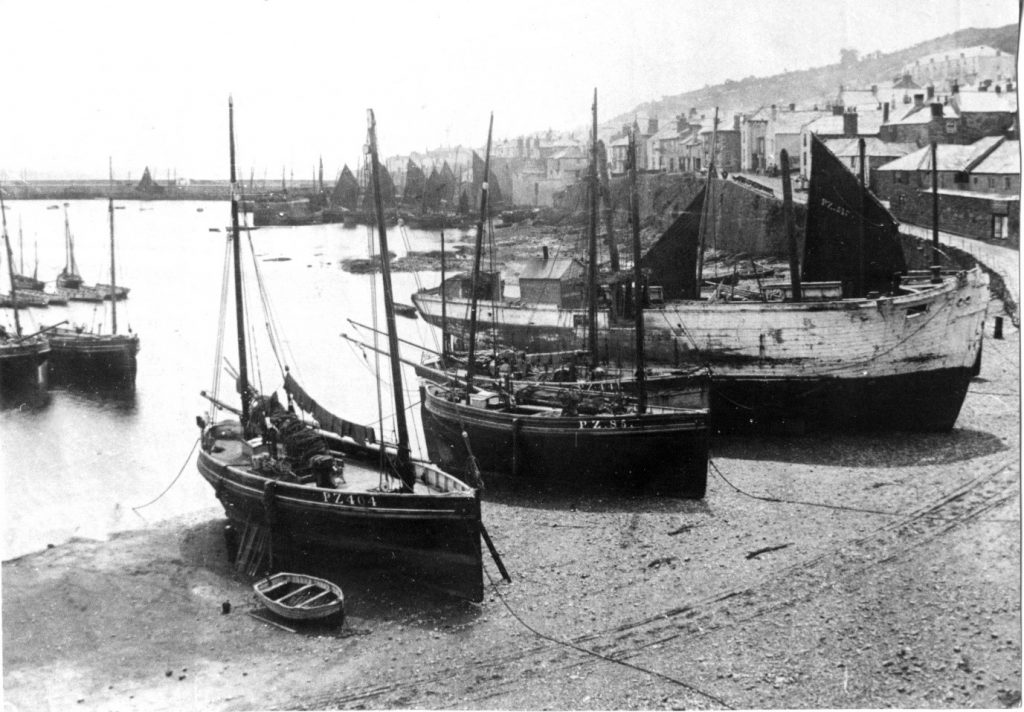
Alpha, PZ85 on the beach between Newlyn Town and Street-An-Nowan
Manchester Evening News – Monday 10 April 1899
Cornishman – Thursday 13 April 1899 (Part 1)
Cornishman – Thursday 13 April 1899 (Part 2)
Cornishman – Thursday 20 April 1899
Mr. William Treneer, whose adventures in the Alpha fishing-boat, which broke out of Newlyn harbour on Friday morning, are pretty well-known, arrived Penzance by the 7.25 a.m.train on Wednesday, after travelling all night from London, where he was taken by the steamer which picked him up in the English Channel. Shortly after his arrival at the house of his son, Mr. Joe Treneer, at Newlyn-town, on Wednesday morning, he was seen by our representative, to whom he related his experience during the previous five days. Mr. Treneer, who is 71 years of age, looks very well, considering what he passed through. Naturally enough, he is still stiff and sore from exposure and the bruises he received from the tiller striking him pretty often, but the old man’s nerves have stood the strain remarkably well.
“We were moored,” he said, “in the harbour, as usual, on Thursday night, and I slept on board The wind woke me early in the morning, and, as I was putting on myboots, I felt something crack into the boat, and it knocked me down in tbe cabin. I ran on deck for my life, and found we were going away—stern first—and I could not hitch to anything. I threw a rope to an East-countryman but he left that go.” His son, Mr. JoeTreneer, here interposed with the remark that the East-countryman said tbe rope never reached him. Mr. Treneer, senior, continuing, said, “When the wind parted a Porthleven boat she came down flying,and her stern cut away the Alpha’s mooring rope, and then she went flying. Out she comes and through the harbour. I went and heaved two anchors out, but they would not hold. She dragged down east of the Mount, and would have gone ashore east of the Green, but I cut one anchor away, having let go other belore. We passed close to Cuddan-point, Trewavas head, and then close to Mullion island. I was laying down steering, so as not to be washed overboard, but every now and then the tiller struck me on the chest.”In reply to a question as to the statement that the boat was seen off Marazion, apparently water-logged, Mr. Treneer said “There was no water in her more than I could cope with by the pump.
“Next we got close to the Rill, over the shoals, and the seas rose up as if they were going to swamp her. But,” enthusiastically exclaimed the old man, “there was no swamping her! I would not be afraid to go over the world in her—if there was canvas on her. We cleared the Rill, and then I was afraid she would not go by tbe Stag rocks at the Lizard. The Alpha went along S., and sometimes S.W., going like a steamer when she got the wind upon the quarter. But I soon saw she was all right for the Stags, and at last she got by. Then I wore her with her head to the eastward, and unshipped the tiller, because I was afraid would break the rudderhead. She drifted down to the Manacles, and I was obliged to wear her again to clear the rocks. Then I thought I would have a drop of tea. (There was always a fire on board.) So I hove-to inside the Manacles and had some tea. This This was about six o’clock on Saturday morning. Asked whether he saw anything of the Cadgwith lifeboat which was out looking for him, Treneer said ” I was never off deck; no liieboat, or man, woman, or child did I see; and I was looking all over the world. After this the wind flew to N.N.W., and the drift of the boat was then south-east. ‘Now,’ I thought, “I shall not see anything,’ and the spray was going over in sheets, and I could not see ihe land. We continued to drift until four o’clock in the afternoon, when Hungarian steamer (the name of which Mr. Treneer could not remember) came up and took me. I asked the captain, when we got to London, how far I was from the land when he picked me up, and
said I was 48 miles SS.W. of Plymouth. I took ropes from him, and he took me in tow, I steering for two hours and a half. Then the ropes broke. They came round and took me again, but in about a quarter of an hour the ropes again parted. Then the pump failed, and the water rose to the fire- place. They heaved a rope again, but I fell upon the deck, and had not any power to make it fast any more. Then I was taken on board. We were 18 miles irom the Start. They carried me to the bed- cabln, and put to a warm feather-tie. and pillows and clothes the same. They padded me all round, took off everything from me, and put up dry clothes. Then they gave gin to wet my lips, and hot tea. Then I came to myself a bit. Two men went down to the boat, but the rope broke again, and then she was left to go—about 13 miles from the Start. And we continued our voyage to London. Clever men they were! ” 44 So you were treated all right ? our representative ventured to remark. “Don’t tell about well’ ” exclaimed Mr. Treneer. “Never hear a foreigner run down any more! They brought me fowls, eggs, wine, gin, every kind of thing you can mention, seven or eiqht times a day, and the captain constantly came to see how I was going on. One man asked if it was worth while to put me the hospital; but the captain says, “He shall never go to the hospital from this ship. I will go ashore and see what I can do. ‘ He went ashore and came back and told me he had made things all right. We arrived at Gravesend on Sunday night, hut I don’t know anything about that, because I was in bed for two days after that. “Soon after we arrived a gentleman came aboard, and was told that the steamer had brought in a man who had been picked up sea. He came to me and said “What’s your name?” “William Treneer,’ savs I. He says ‘You’re drowned.’ ‘No,’ says I. ‘I am not drowned: l am living aboard this steamship.’ He read a caper to me which said I was drowned. He asked if he should send a telegram. should send a telegram. 4 ‘Yes,’ says I, ‘send as many as you like.’ Replying further questions Mr. Treneer said did not hear that the Alpha was safe at Brixham until that morning, when be was told the train. As his state of mind while drifting he said he never felt any different than if was ashore. When saw dangerous sea coming he used to jump down in o the cabin, so that he should not be carried overboard. The wind and sea carried away tbe rigging aft, her bulwarks were beaten away cn the port side, and one or two stanchions had gone. Mr. Treneer was unable to see much London, but he was amazed the mass and intricacy of the traffic the streets, and once had a small adventure in getting lost. He was travelling with two gentlemen in a train, but be took a long time to alight from the carriage after them, and the result was he was taken on further than he expected. However he was overtaken few minutes. all events he will long have cause to remember the memorable Cruise of “The Alpha.” Death from blood-poisoning, brought about by the chafing on his foot of a knot in his boot-lace, was the verdict at an inquest iust held on the body of a boy named Cox, at Redbourne, Herts. Ten Francs was the reward which lady offered to a Paris ‘bus conductor on Saturday for returning to her a reticule containing 105.000 francs notes which she left his ‘bus. Tbe conductor, however, declined the princely